Isaac woke me up at 6:30a this morning to go launch some rockets. Unfortunately, I had a production deployment at 2a this morning, so I was slow to get out of bed. We finally hit the launch site around 7:45a and had some nice launches. It was a beautiful, warm morning; winds were calm.
Our first launch was a new Estes Bandit that the local hobby show, Mile Sky Hobbies, gave us. The owner had hosted a build 'n take booth at an air-show recently and we weren't able to attend so he gave us the model that he had built for demonstration. The rocket is an E2X kit and flies nice and straight. Our first flight was on an A8-3 just to verify that it would fly straight.
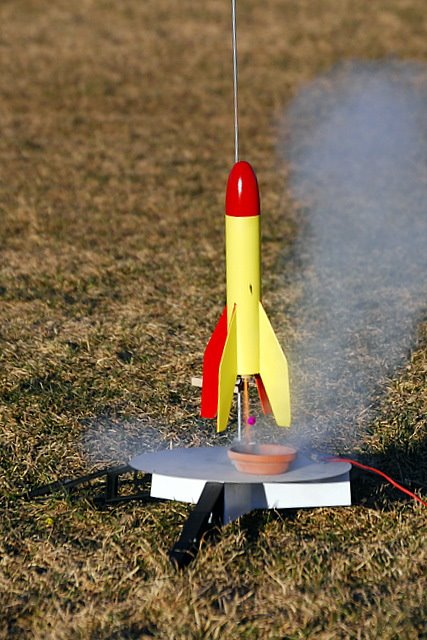
Second flight was the tiny, yellow Estes Sting Ray. Isaac did all the prep including the motor install and launch connection and then launched. We launched with a 1/2A3 and the tiny thing still went high and far.
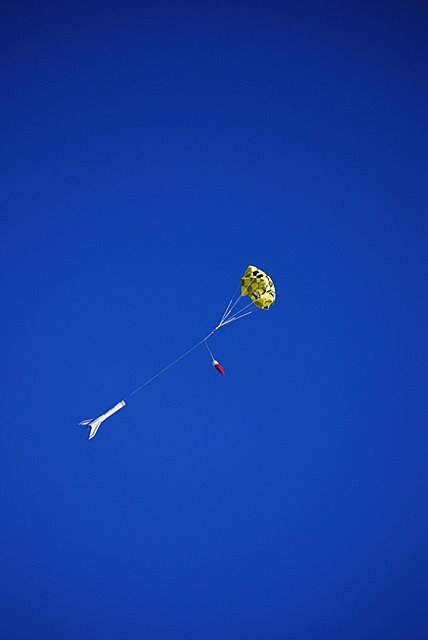
Mighty Mouse took a turn on a B6-6 and had a great flight, as always. Next, Isaac prep'd the Estes Swift for it's first flight. Using a 1/2A3, the rocket went far out of site up and a little to the north. We heard the motor ejection, but couldn't see any trace of the rocket or smoke. Isaac is convinced that the Swift is orbitting earth at this very moment.
The String Ray flew next on a B6-4. The glide from powered flight to apogee was impressive. Mighty Mouse flew on a B6-6 and then we flew the String Ray one more time on a B6-6.
That's 7 flight... I think we had 8 launches... I'm forgetting something. I better start carrying paper or a computer to the launch to record! Launch prep was far better this time and I remembered all launch rods and parachutes today :)
Thursday, June 21, 2007

Monday, June 18, 2007
Under Construction: Talon 2 and Rhino II
In the smallish rockets that I build, the motor mounts have been pretty fun lately. The two main rockets that I'm working on at the moment are the Talon 2 and the Rhino II. The Rhino II is my second Rhino: the first is a cluster with 4 13mm motors; the Rhino II will fly with 5 13mm motors.


The Talon 2 my first Talon kit - it just has a 2 in the name because Giant Leap makes a bunch of different sizes of the kit. This kit is a 'high power' kit similar to the Bullet, but far more complex to build. The motor mount is shown below just before I assembled it into the rocket. The black on the one end is the motor retainer that uses snap rings rather than a screw-on cap like the retainer on the Bullet. The wire loop on the motor mount is the shock-cord mount - again, different from the U-bolt used by the Bullet.


The motor mount in the Talon 2 is 29mm in diameter and about 18" long: that's pretty big for as small a rocket as it is. It uses G-10 fins which is a new material for me to work with. G-10 is necessary for bigger, faster rockets because it is a lot stronger and less flexible than plywood. One curiousity is that it uses a nylon shock-cord with kevlar sleeve rather than a simple kevlar shock-cord - I'm not sure why that is yet.
Monday, June 04, 2007
NCR June Launch
No - I didn't launch the Bullet this weekend. It was an awesome weekend of rocketry, though.

In the picture above, the two rockets were supposed to drag-race. I believe that the rules are the winner has the best 2 out of 3 of: first to altitude, highest altitude, and first to land. Art, with his BAMF, was the obvious winner in this launch because Dougs camera rocket didn't fire. The next day, they tried again and both rockets launched, but Doug's rocket was only thinking about getting to the ground first: it went up, turned over and went back down. I'm pretty sure it was super-sonic by the time it landed because it was really screaming and I was well over a mile away and could here it quite loudly. The nose cone was buried 2 feet in the hard-packed desert dirt. Art won again.
Later on the day, after dozens of other cool flights, this 14 foot long Saturn V launched. Most impressive:


In the picture above, the two rockets were supposed to drag-race. I believe that the rules are the winner has the best 2 out of 3 of: first to altitude, highest altitude, and first to land. Art, with his BAMF, was the obvious winner in this launch because Dougs camera rocket didn't fire. The next day, they tried again and both rockets launched, but Doug's rocket was only thinking about getting to the ground first: it went up, turned over and went back down. I'm pretty sure it was super-sonic by the time it landed because it was really screaming and I was well over a mile away and could here it quite loudly. The nose cone was buried 2 feet in the hard-packed desert dirt. Art won again.
Later on the day, after dozens of other cool flights, this 14 foot long Saturn V launched. Most impressive:

Monday, May 28, 2007
Launch Log 2007.05.28
Isaac, Jeremiah, Luke, Emma, and Megan launched rockets today. We had 5 launches total with 2 of them being first flights. We need to start tracking how high the rockets go, but at this point we just see them as low, high, or really high.
The first launch was Might Mouse I with an A8-5. The Mighty Mouse is good to fly on a C, but I wanted to start with an A to introduce the girls to rockets. I think we should stick to A8-3 or just go with B or bigger in the future because the 5 second delay put the chute opening about 16 feet above ground (I was nervous).
Our second launch was the recently completed SpaceShip ONE. We used an A8-3, but that didn't work out so well. I think we'll try it again on a C, but I may not have gotten the wings straight because this launch was just kart-wheeling off the rod. We did a first flight of the UNNAMED: it flew decent and then melted the chutes on deployment. It recovered fine (fortunately, one of the chutes fully opened), but I'll have to figure out how to properly pack the chutes.
We finally launched the Alpha and the Outlaw. Both had great flights. The Alpha flew on a C6-7 and the Outlaw flew on a C6-5. Both were recovered in the same field, thanks to the calm weather. The paint on the Alpha is bubbled, so Luke and I suspect that the heat is causing it some problems. We may have to retire this one and get a new one for future flights.
The first launch was Might Mouse I with an A8-5. The Mighty Mouse is good to fly on a C, but I wanted to start with an A to introduce the girls to rockets. I think we should stick to A8-3 or just go with B or bigger in the future because the 5 second delay put the chute opening about 16 feet above ground (I was nervous).
Our second launch was the recently completed SpaceShip ONE. We used an A8-3, but that didn't work out so well. I think we'll try it again on a C, but I may not have gotten the wings straight because this launch was just kart-wheeling off the rod. We did a first flight of the UNNAMED: it flew decent and then melted the chutes on deployment. It recovered fine (fortunately, one of the chutes fully opened), but I'll have to figure out how to properly pack the chutes.
We finally launched the Alpha and the Outlaw. Both had great flights. The Alpha flew on a C6-7 and the Outlaw flew on a C6-5. Both were recovered in the same field, thanks to the calm weather. The paint on the Alpha is bubbled, so Luke and I suspect that the heat is causing it some problems. We may have to retire this one and get a new one for future flights.
Thursday, May 24, 2007
Alberto Santos-Dumont
I've not read about Alberto until now. From the little information that I have read so far in Wikipedia I suspect at least a few of the early Tom Swift books were based around this man and his achievements. I'll have to find a book about him.
It was while I was looking for information about personal blimps that I saw Alberto's name. I was reading the FAQ about the Alberto airship from SkYacht and they pointed out that they named the ship after this pioneer of aviation.
Isn't it beautiful:
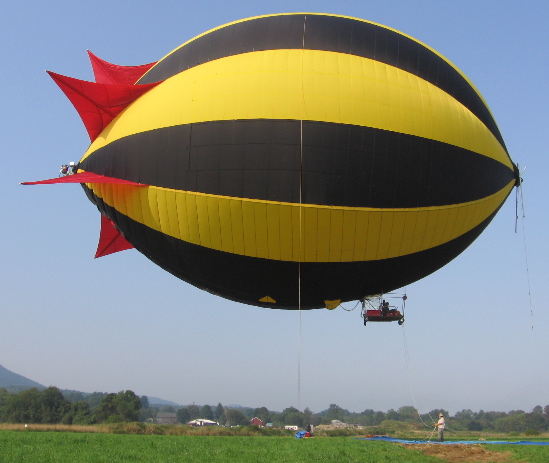
It was while I was looking for information about personal blimps that I saw Alberto's name. I was reading the FAQ about the Alberto airship from SkYacht and they pointed out that they named the ship after this pioneer of aviation.
Isn't it beautiful:
Saturday, March 10, 2007
Launch Log 2007.03.10
Today was our first time launching a cluster. This one was the FlisKits Rhino with a 4-motor cluster built with centering rings from Jon's Colorado Rocketry Components.
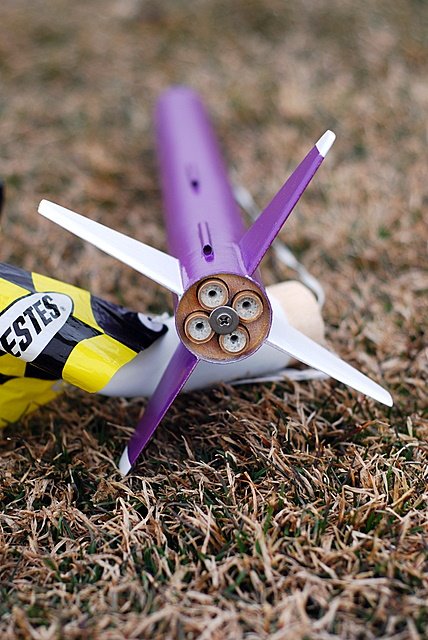
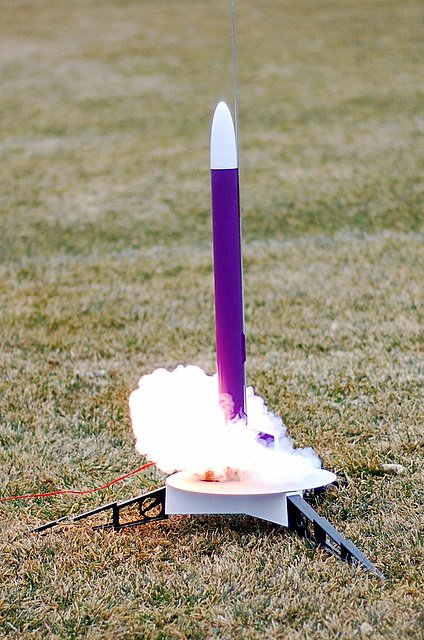

The Rhino had two flights and both were amazing. The first flight was on 4 A3 motors and the rocket proved to flight straight. I did a quick clean-up, regreased, reloaded, and took a second flight with 4 A10's.

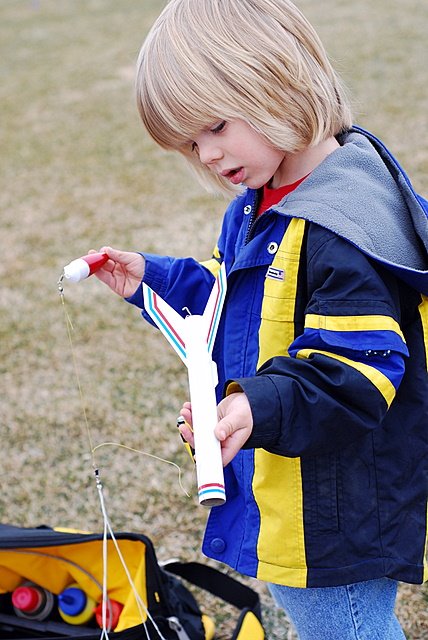
After flying the Rhino, we flew Isaac's Alpha on a C6-7... we were sure we lost the rocket because there was no sight of it even a couple minutes after the launch. While Spencer and I were over in the field to the east of the launch field, we noticed the Alpha decending over the field to the south of the launch field. Wowsers - we'll have to get a pico altimeter and beacon installed in the Alpha before another flight on a C motor!

Monday, March 05, 2007
Launch Log 2007.03.04
We had a beautiful day for a launch at the school by our house today. It was a little breezy, so we started the launch with a C6 in the Outlaw to get an idea what to expect. It was a very pretty flight because the motor was extra smoky and went nice and high.

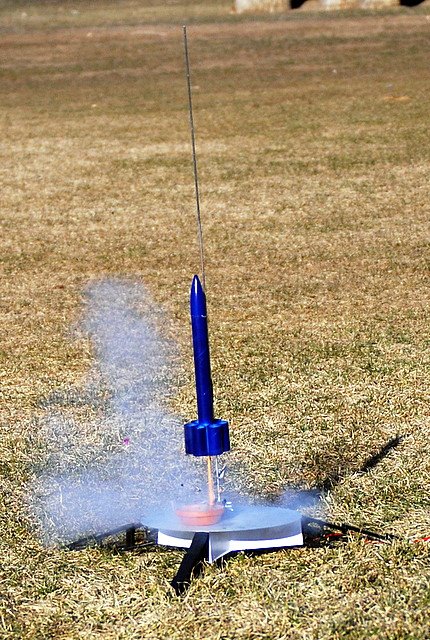
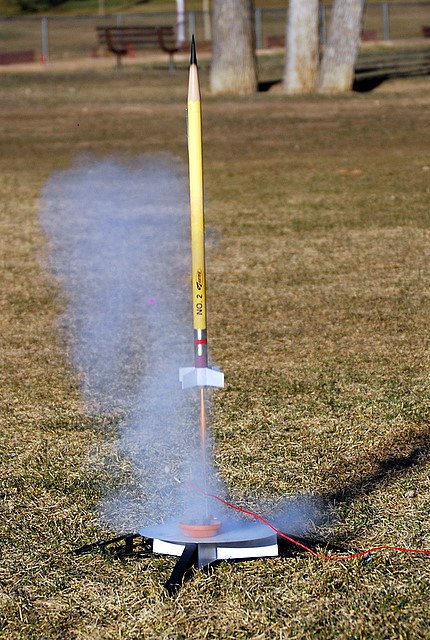
Those were the last launches of Pipes and Pencil: Pipes got tangled up in power lines and I have no idea when the power company will get it down and I doubt they'll bring it to us; Pencil was flying without a chute (because we forgot all of our chutes at home) and it turns out it doesn't do tumble-recovery so well. BTW, Pipes and Outlaw do tumble-recovery perfectly.
Shanelle went home to get chutes and then we were able to fly some more. Isaac did the prep on his Alpha rocket from Seth. The Alpha had a nice launch, but on its first flight the chute was tangled so it bounced.
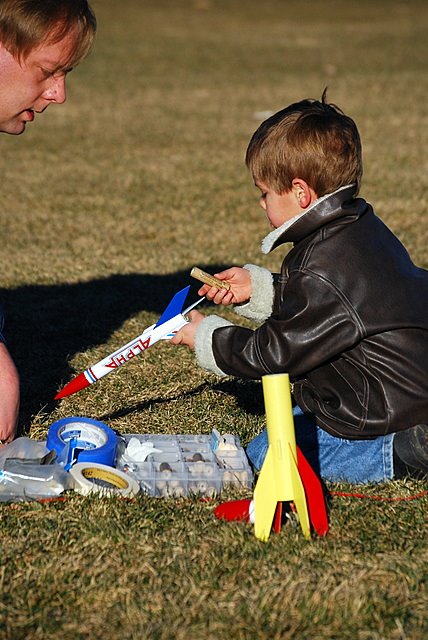


Afer the Alpha launch, Spencer decided he was ready to launch his rocket from Seth - the Mighty Mouse. Mighty Mouse flew a couple times and as always it flew beautifully.
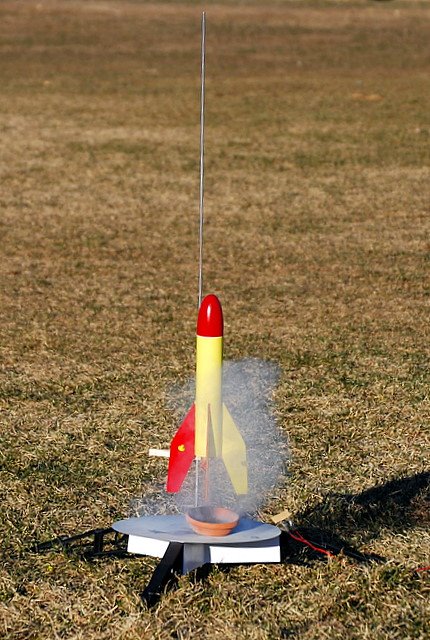

The flight was great, but got a little scary because it looked like it was coming down in a tree. It must have been just past the tree or flew through the branches.


The Alpha taking a second flight - the recovery pictures are interesting because we replaced the usual rubber shock-cord with Kevlar thread. The thread is often used in contest models because it is light.


Spencer did the count-down and pushed the button on 3 launches: 1 launch of the Pencil and 2 launches of the Mighty Mouse. He even recovered Mighty Mouse after its second flight.


Saturday, March 03, 2007
March Launch Scrubbed
We went to the launch site today. The launch was 'go' as of last night, but a dozen or so of us arrived at the launch site this morning at 9a and high winds made it clear we wouldn't be launching. We waited until about 10:30a to see if the winds would die down but they didn't so the club president officially scrubbed the launch and sent the equipment trailer away :(
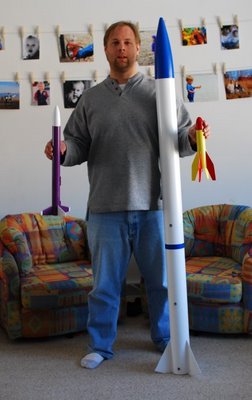
Above is a picture of the rockets that I took with me to the launch. I had expected to make my first high-power flight with the bullet today. While I didn't get to fly, I did get a chance to ask another club member to look over the rocket. The red and yellow is an Estes Baby Bertha kit that we've named Mighty Mouse - I actually took two of those today: one with a since 18mm motor mount and one with a cluster of 3x13mm motor.
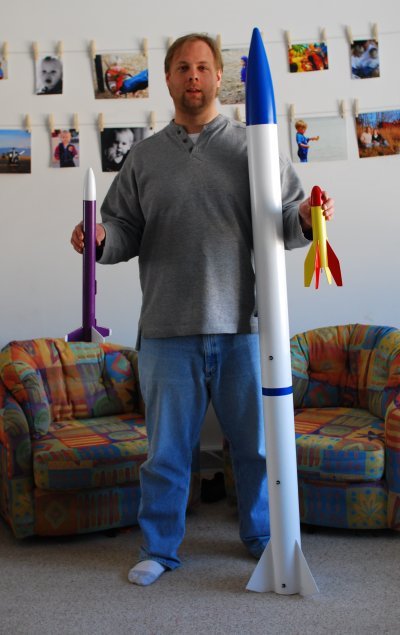
Above is a picture of the rockets that I took with me to the launch. I had expected to make my first high-power flight with the bullet today. While I didn't get to fly, I did get a chance to ask another club member to look over the rocket. The red and yellow is an Estes Baby Bertha kit that we've named Mighty Mouse - I actually took two of those today: one with a since 18mm motor mount and one with a cluster of 3x13mm motor.
Tuesday, January 30, 2007
The Astronaut Farmer
I first heard about the Astronaut Farmer while looking at the CP Technologies Web site (my quest for ideas on small-scale strap-on booster designs). There was a lot of information there about the movie and skimming the info, I decided that I'd like to go to the movies on Feb 23 (opening night). It worked out that I was able to go a screening of the show today - great movie, in my opinion.
There was a point in the movie where there is a failure and I was horrified: I thought that the BATFE had worked with the Polish Brothers to help the public see the 'light' on their current case affecting rocket propellant and ignitors used by hobbyists. In the movie, it is the FBI rather than the BATFE, but a similar idea (Farmer was fine building his rocket - it was when he attempted to buy fuel that he got into trouble - even though he had attempted to follow known regulations).
There is a lot of family focus in the movie - the kind that I like because it helps me consider my role as a parent and gives me some things to think over. Some details are ignored - again, a nice thing - for example, Farmer allows the public to come into his garage and see the rocket and the line goes on for miles (apparently, these were only the most well behaved humans on the planet because there was no mess and no fights). I believe that the movie was filmed in New Mexico - I only mention it because the house, the ranch, etc. were so pretty that they really complimented the story / experience.
Good stuff.
There was a point in the movie where there is a failure and I was horrified: I thought that the BATFE had worked with the Polish Brothers to help the public see the 'light' on their current case affecting rocket propellant and ignitors used by hobbyists. In the movie, it is the FBI rather than the BATFE, but a similar idea (Farmer was fine building his rocket - it was when he attempted to buy fuel that he got into trouble - even though he had attempted to follow known regulations).
There is a lot of family focus in the movie - the kind that I like because it helps me consider my role as a parent and gives me some things to think over. Some details are ignored - again, a nice thing - for example, Farmer allows the public to come into his garage and see the rocket and the line goes on for miles (apparently, these were only the most well behaved humans on the planet because there was no mess and no fights). I believe that the movie was filmed in New Mexico - I only mention it because the house, the ranch, etc. were so pretty that they really complimented the story / experience.
Good stuff.
Monday, January 29, 2007
Feb launch scrubbed but...
I'm not too down: on Monday, January 29th, I'll be attending a screening of The Astronaut Farmer and when we do get to launch, I'll be attempting my L1 cert on my second flight of the Bullet. I've been assisting with some PHP on the club Web site and one of the members showed me the casing and motor I'll be using for my L1 :) I'll have to pay for the H73 motor, but I'll be able to borrow the casing.
Friday, January 19, 2007
building a few cluster models
We have a rocket day coming in the next month or two at church, so I'm building a couple models size rockets for launching there. These are my first venture into clusters - and they are tiny clusters. The tall rocket is a Rhino and the shorter one is a Baby Bertha.
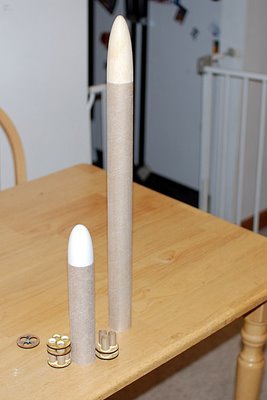
Both rockets use BT-60 size tubes, so I picked up a couple cluster mounts from a local rocket guy. The Baby Bertha will use 3 tiny A motors and the Rhino will use 4; this will give the Baby Bertha about 6.6 N-s and the Rhino 8.8 N-s of total impulse (equivalent of mid-C).
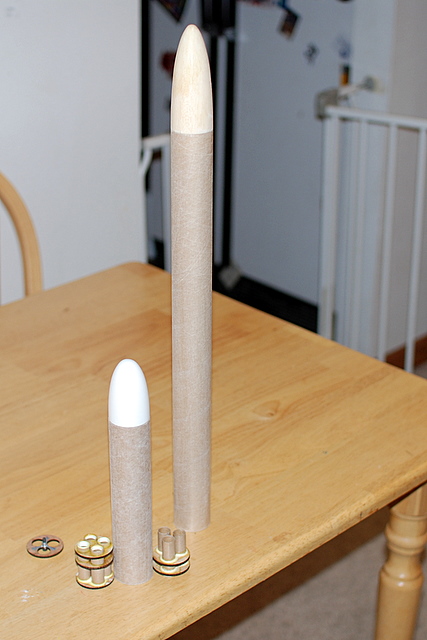
Both rockets use BT-60 size tubes, so I picked up a couple cluster mounts from a local rocket guy. The Baby Bertha will use 3 tiny A motors and the Rhino will use 4; this will give the Baby Bertha about 6.6 N-s and the Rhino 8.8 N-s of total impulse (equivalent of mid-C).
Wednesday, January 03, 2007
Jan 6 launch scrubbed
Disappointing :(
- from http://www.ncrocketry.org/
Regrettably but sensibly, NCR will NOT attempt to launch on Saturday the 6th. Our equipment trailer remains buried in deep snowdrifts and is pretty much in-accessible, as is the Atlas Site.
Tuesday, December 26, 2006
preparing for first Bullet flight
Still have some finishing work to do on the Bullet, but it is nearly ready for its first flight. I'm planning on flying a couple flights on Jan 6 at the Northern Colorado Rocketry launch.
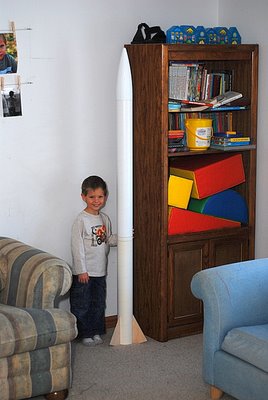
In this picture, the base kit has had an avionics bay and an extension added. The avionics bay will carry the electonics that Michael and I have been working on. The extension is simply there to connect the avionics to the nose cone, but the additional length helps the rocket fly stably with heavy tail.
One last bit (besides the finishing of the rocket) is to test fire a motor. I'll be using a reloadable motor system and I need to verify that I can safely assemble and fire the engines without it blowing up or failing to fire the ejection :)
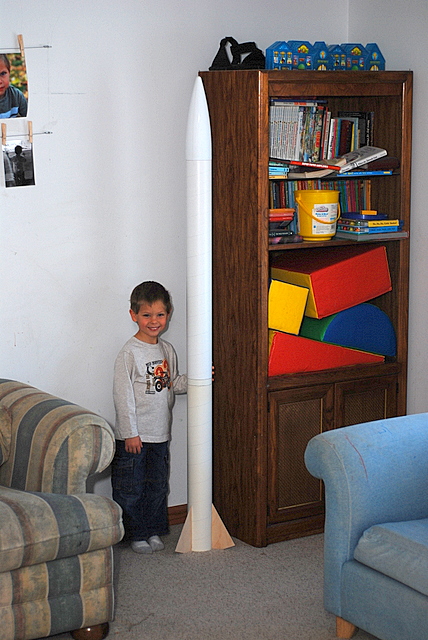
In this picture, the base kit has had an avionics bay and an extension added. The avionics bay will carry the electonics that Michael and I have been working on. The extension is simply there to connect the avionics to the nose cone, but the additional length helps the rocket fly stably with heavy tail.
One last bit (besides the finishing of the rocket) is to test fire a motor. I'll be using a reloadable motor system and I need to verify that I can safely assemble and fire the engines without it blowing up or failing to fire the ejection :)
Thursday, December 21, 2006
some individuals weights
I've been wondering how much my quick links weigh and other individual parts. I finally got around to weighing the stuff this evening:
It's kinda funny that I differentiate between 1/2 and 1/3 because my scale isn't that precise, but that's the way I read it.
- 1200 lbs quick link - almost exactly 1 oz
- 800 lbs quick link - about 1/2 oz
- 660 lbs quick link - about 1/3 oz
- 16 ft kevlar - about 3/4 oz
It's kinda funny that I differentiate between 1/2 and 1/3 because my scale isn't that precise, but that's the way I read it.
Saturday, December 16, 2006
device direction
We're trying to make a decision on the device that we want to commit to. We've been bouncing between the PIC and the AVR for a while and feel that we need to pick one to focus on. In my initial research, it seems like the AVR and PIC are pretty much equivalent competing products. I have seen some vague references (i.e. both device families have similar features as well as unique features so the process of choosing one can be daunting) to differences in the families, but nothing helpful or specific yet.
Michael has gathered some great links. We'll likely consider where we want to be in the longer term (guidance) and see if one of the product families fit better than the other.
Michael has gathered some great links. We'll likely consider where we want to be in the longer term (guidance) and see if one of the product families fit better than the other.
Wednesday, December 13, 2006
testing R/C with an igniter
I hooked everything up expecting to be disappointed. I thought that it was all good in theory, but it surely wouldn't work in practice. Making a hot fire would surely be more difficult that turning on an LED.
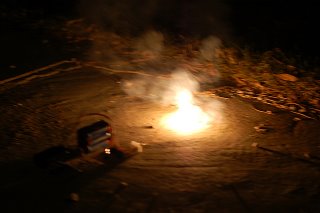
In the first attempt, I took the pictures and I am all sorts of no good at taking pictures. Shanelle assisted in the second attempt by taking some excellent pictures. I hooked everything up and told Shanelle what to expect and then flipped the switch.
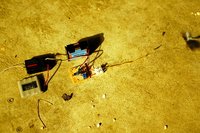
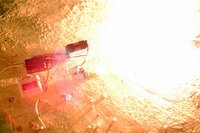
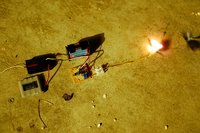
It takes about 3 seconds for the igniter to get hot enough to fire. I'm just using a 6 cell AA pack of NiMH batteries. The total voltage is 8.4 volts - quite a bit lower than the preferred 12 volts. It's nice that the igniters were willing to give me joy on the 8.4.
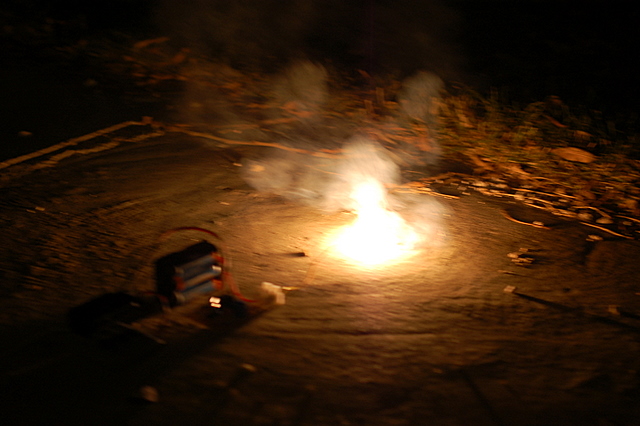
In the first attempt, I took the pictures and I am all sorts of no good at taking pictures. Shanelle assisted in the second attempt by taking some excellent pictures. I hooked everything up and told Shanelle what to expect and then flipped the switch.


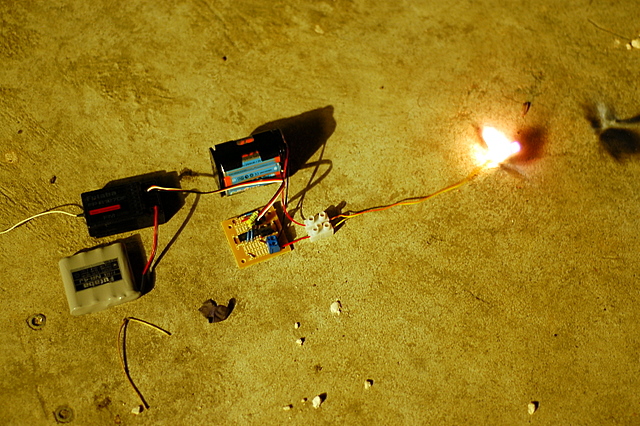
It takes about 3 seconds for the igniter to get hot enough to fire. I'm just using a 6 cell AA pack of NiMH batteries. The total voltage is 8.4 volts - quite a bit lower than the preferred 12 volts. It's nice that the igniters were willing to give me joy on the 8.4.
Tuesday, December 12, 2006
another post about the R/C backup circuit
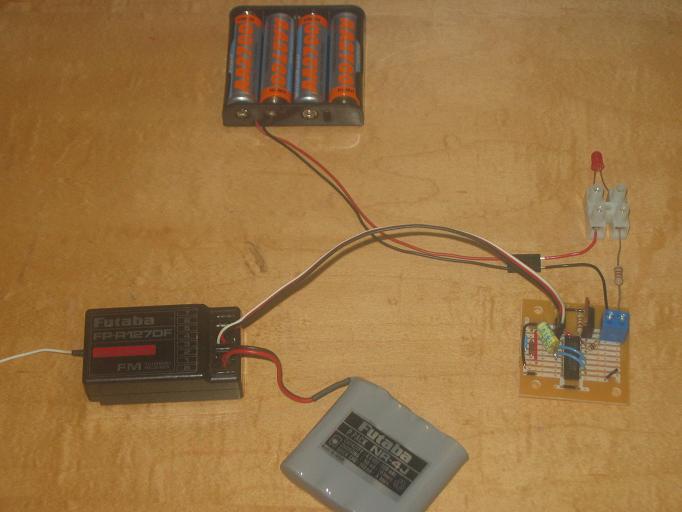
I tested the R/C circuit with a few different types of capacitors and 4013s. Actually, the 4013 that I had been using was SGS and tonight I tested with a Motorola one. Of course, one expects them to work the same, but I needed to try it to make sure. The yellow capacitor that is in the circuit is one that I picked up last week: a fancy poly cap that isn't truely a precision capacitor, but it is rated at +/- 1%. The black boxy one sitting next to the bread board is +/- 10%. The green one is the one I have been using and is also +/- 10%.
The difference between the two images above is the position of the gimble. Turning the LED on when using the 1% capacitor takes 1 click at the center of the throw. When I use the black box capacitor, it takes 2 clicks about 2/3 up in the throw. When using the green capacitor, it takes 2 clicks at the center. After 1 click from off, the lower precision capacitors flicker. Of course, in real action, I'll use the switch (top left of the controller), but the gimble adjustment seems like a good test to see where the circuit is sensitive.
I feel good about the reliability of the circuit and parts availability, so it is time to solder a version together and test the first circuit with some higher current. The yellow capacitors are expensive at 30 cents each, but not prohibitively expensive - I think that I'll start with those and I'll use the Motorola 4013 since I have more of those than the SGS. The firing mechanism is currently using an IRF 531, which are locally available, so I'll be putting that into the initial prototype.


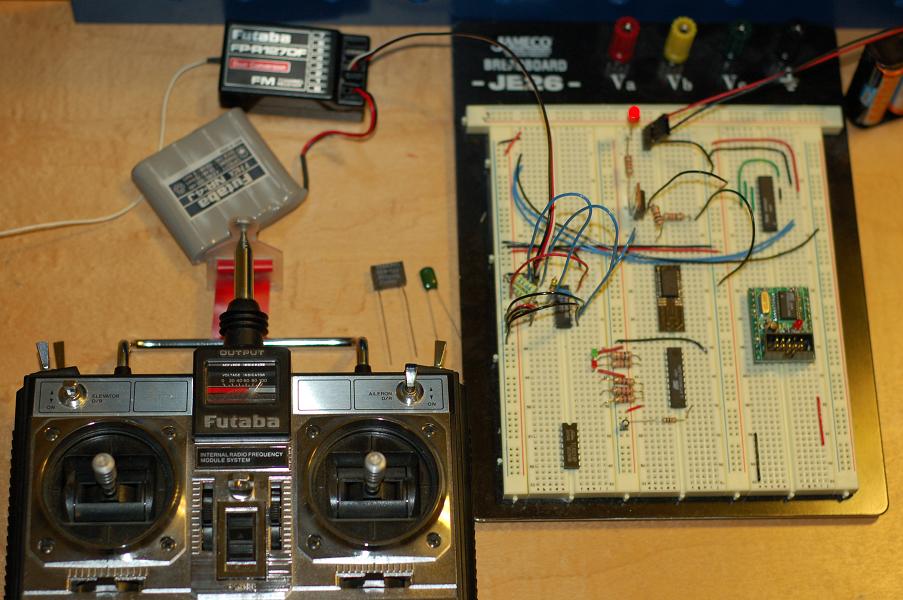
The difference between the two images above is the position of the gimble. Turning the LED on when using the 1% capacitor takes 1 click at the center of the throw. When I use the black box capacitor, it takes 2 clicks about 2/3 up in the throw. When using the green capacitor, it takes 2 clicks at the center. After 1 click from off, the lower precision capacitors flicker. Of course, in real action, I'll use the switch (top left of the controller), but the gimble adjustment seems like a good test to see where the circuit is sensitive.
I feel good about the reliability of the circuit and parts availability, so it is time to solder a version together and test the first circuit with some higher current. The yellow capacitors are expensive at 30 cents each, but not prohibitively expensive - I think that I'll start with those and I'll use the Motorola 4013 since I have more of those than the SGS. The firing mechanism is currently using an IRF 531, which are locally available, so I'll be putting that into the initial prototype.
Saturday, December 09, 2006
all power
This car is all power. In fact, before Isaac installed the house, he decided it was too much power for his lego man. He installed a man with a helmet and we had to brainstorm to come up with a seat belt before taking any more drives!
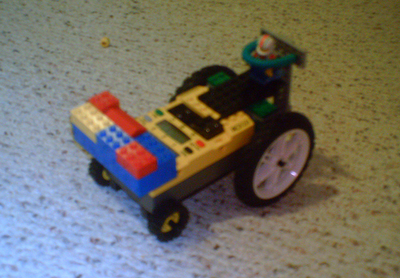
Note that this was taken with the boys' camera... it isn't a Canon / Nikon thing.

Note that this was taken with the boys' camera... it isn't a Canon / Nikon thing.
Thursday, December 07, 2006
XM Radio Constellation
I was curious to find out how big the XM Radio constellation is because I was so impressed with our reception on our Thanksgiving trip to the mountains. On our way back from the cabin we rented, we took some roads that were in between mountains and deep in the trees and we never lost reception.
Well, the XM Radio wikipedia entry has lots of great info, but it wasn't immediately obvious how big their constellation is or current orbits. While searching around, I bumped into the decode systems page which led me to VITA.
I know nothing about VITA - perhaps they are scum; however, the interesting bit to me is that there is a group of volunteers that have a license for a satellite constellation. Interesting. Serendipity do day.
Well, the XM Radio wikipedia entry has lots of great info, but it wasn't immediately obvious how big their constellation is or current orbits. While searching around, I bumped into the decode systems page which led me to VITA.
I know nothing about VITA - perhaps they are scum; however, the interesting bit to me is that there is a group of volunteers that have a license for a satellite constellation. Interesting. Serendipity do day.
great capacitor resources
I'm struggling to grok all that capacitors are and do. Here are a couple resources that I assume that I'll keep coming back to. Capacitor Concepts has a nice graph about types of capacitors, what they are used for, and related equations for the different types and uses. This site details the meanings of various capacitor markings - important for me because I have accumulated a bunch of capacitors and very few say helpful things like 10uF 50VDC; most of my capacitors say things like 0.1k or 103M.
Subscribe to:
Posts (Atom)